
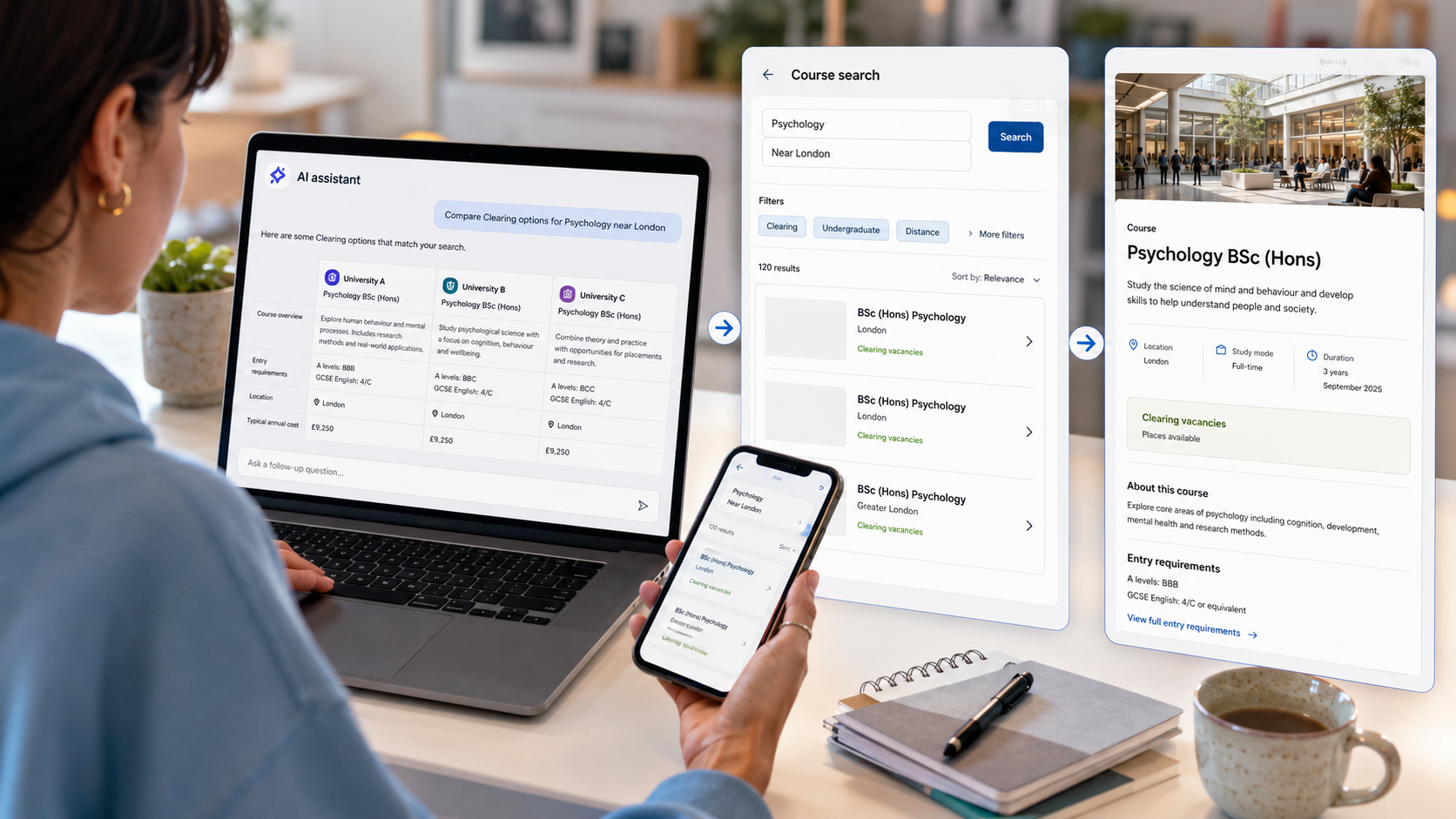
Clearing 2026 is taking place against a noticeable shift in how prospective students research their options. UCAS research found that 88% of students surveyed had used AI. Almost half of those using it did so to explore higher education options, with 61% valuing it for comparing their options.
Instead of clicking through multiple websites, students ask chatbots and AI-powered search engines to compare universities, explore courses, check their options and narrow down a shortlist before visiting UCAS or a university website.
The picture is still developing, but one thing is becoming clear: AI is becoming part of the journey to Clearing. For universities, that raises a practical question: how do you make sure prospective students can find and trust your information when their research may start somewhere other than your website?
More students are still looking for a place
Clearing is a bigger part of the university recruitment picture this year. One day after Level 3 Results Day, 155,030 applicants were still free to be placed through Clearing, up 10.3% from 140,580 at the same point in 2025. Overall applications also increased by 4%, from 676,480 to 703,610.
The increase isn’t simply about more people applying. A larger proportion of students are reaching the point where they need to compare their options and decide what comes next. Among offer holders in England, Northern Ireland and Wales, the proportion placed at their firm choice fell from 71.7% to 68.6%. At the same time, the share free to use Clearing rose from 8.4% to 9.6%.
For universities, that means more students may be making important decisions under pressure. They need clear answers about available courses, entry requirements, locations, costs and what happens next. Understanding where those students are looking for these answers is becoming just as important as understanding what information they need.
AI is becoming an important part of the Clearing journey
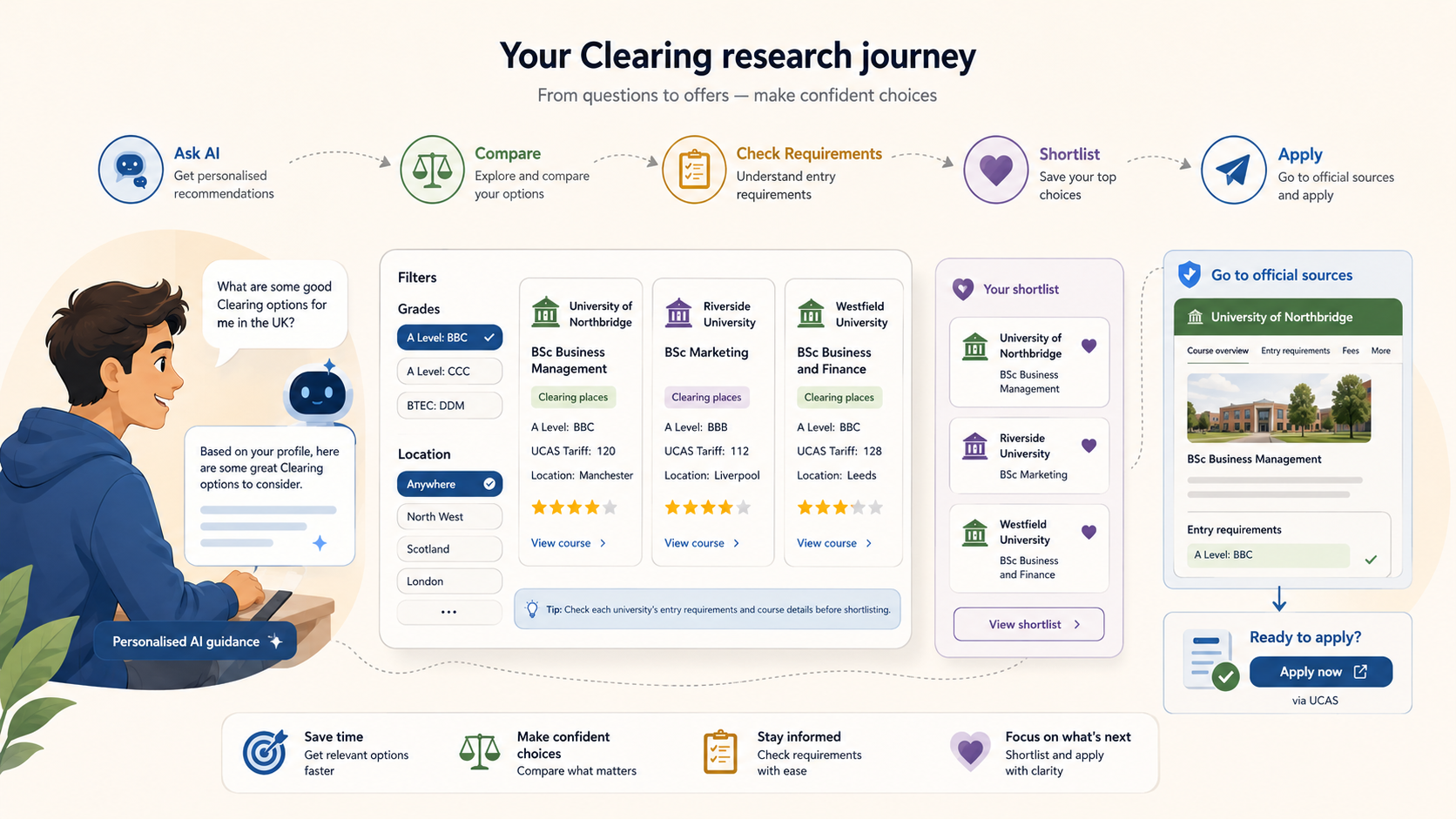
A few years ago, a student may have searched for “Clearing courses near me” on Google and worked through several results.
Chatbots and AI-powered search engines now sit between the student’s initial questions and the websites they eventually visit. Students might start by asking Gemini, ChatGPT, or a Google AI-generated summary for a comparison or shortlist. To generate these responses, AI brings information from different sources, helping the student narrow down their options before they visit an official website.
This may also be changing how students use UCAS. From UCAS-reported internal observations, traffic was down 4 to 6% year-on-year before Results Day. This can partially be attributed to students using tools such as Claude and ChatGPT for their initial research. The same observations suggest that students who did reach UCAS viewed more pages and stayed longer than the previous year.
These observations aren’t supported by a public report, but they do offer an interesting indication of how the role of UCAS might be changing. The student journey involves some form of AI being used for initial research with UCAS and university websites visited for verification. This difference is subtle but important.
University websites may no longer be the first place every student goes to discover their options, but they remain the place where students can check the facts and make a decision with greater confidence.
AI isn’t replacing search; it’s changing what happens before the click
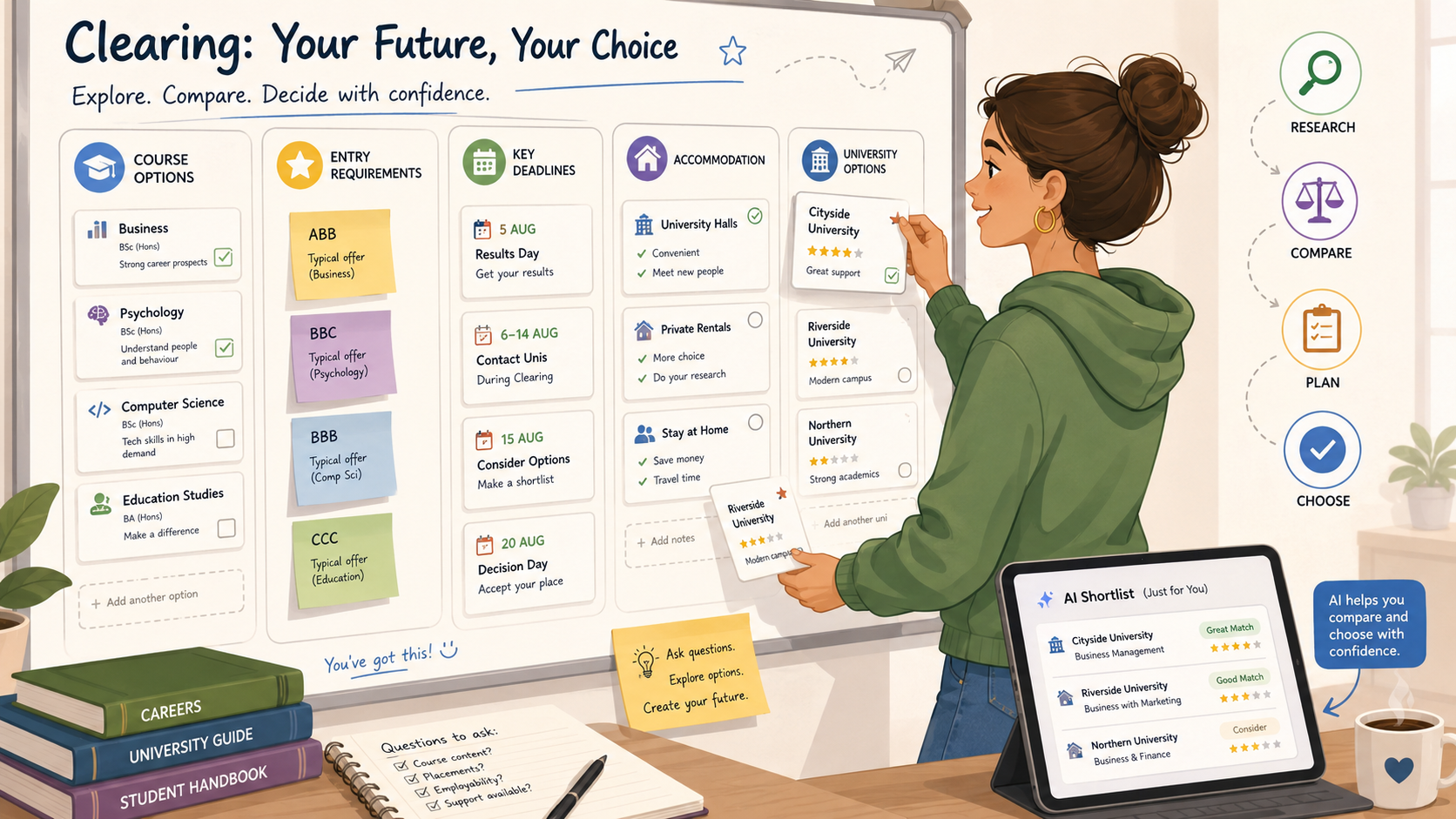
UCAS reported that Google use increased from 28% in 2024 to 40% in 2025. Its own search tool also rose from 38% to 45%. As the data shows, AI isn’t replacing traditional search because students are still using Google and the UCAS search tool to find Clearing options. What is changing is the number of ways students can research before they reach a university website.
A study of general Google searches in the US by the Pew Research Centre revealed that users clicked a traditional search result in 8% of visits when an AI summary appeared, compared with 15% when one did not. Only 1% clicked on a link within the AI summary. This doesn’t prove that the same pattern is happening in UK Clearing, but it does show how answering more of a user’s question within the search experience can change what happens next.
Third-party traffic tools also offer an indication of how difficult this new environment is to measure. A Semrush snapshot of UCAS o 17 August 2026 showed no detected AI traffic in its model, while Similarweb estimated around 3.5 million visits to UCAS in July 2026. Although these figures shouldn’t be treated as definitive traffic data, the difference between the two platforms is a useful reminder that AI-driven discovery isn’t always easy to measure.
What this means for university visibility
For universities, this means visibility can’t simply be about ranking highly for a list of traditional search terms. Your information might be displayed in a Google result, an AI-generated summary, a conversational answer, or the UCAS platform itself.
Wherever the student starts their journey and first discovers you, the opportunity is to make sure that they can find clear, specific and authoritative information about your courses and institution.
That doesn’t mean abandoning SEO. It means thinking beyond the click. If AI is helping students narrow down their options before they visit your website, being visible at that earlier stage matters too.
How to prepare your university for AI-driven Clearing
For situations where AI is helping students narrow down their options before visiting a university website, the role of university content becomes more important, not less. The information students see needs to answer their questions quickly and give them confidence that they’re looking at the right course and institution.
Answer the questions students are likely to ask
Make key information easy to find. This includes modules, entry requirements, accreditation, location, costs, accommodation, student support and graduate outcomes. The aim isn’t to provide content for the sake of it. It’s to make sure students can find useful answers when they’re comparing their options.
Keep information clear and current
Use straightforward headings, short summaries and question-and-answer sections where they make sense. Keep URLs consistent and show when important information was last updated. Structured data can also help search engines and AI systems understand the information on the page and reference it in AI-generated answers.
Plan for students who already have a shortlist
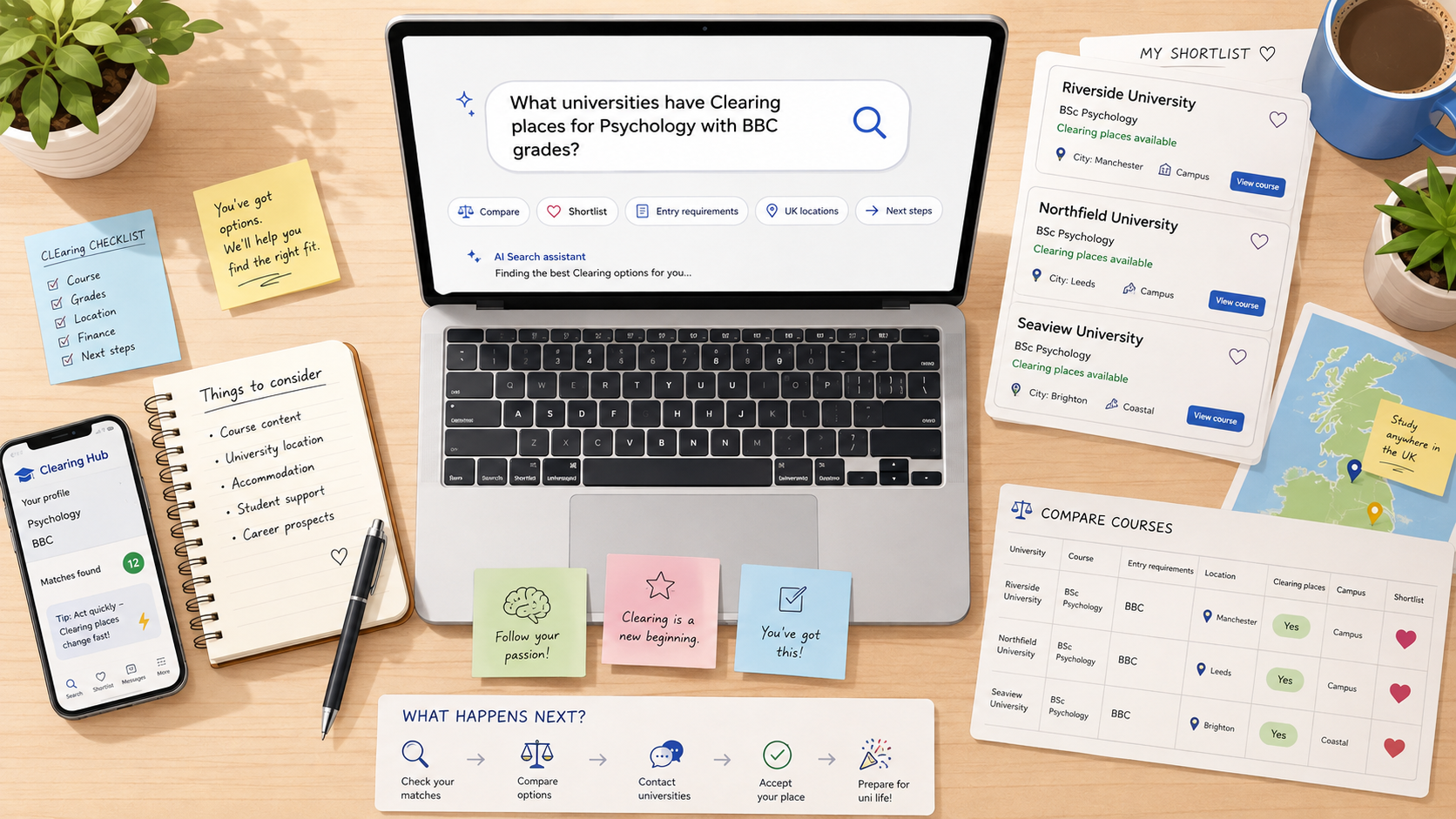
If a student has already used AI to narrow down their options, they don’t need to spend 10 minutes searching for the next step. Make live Clearing places, contact details and application information easy to find, particularly during the busiest periods.
Support your claims with specific information
Statements such as “great student experience” don’t tell a prospective student much. Details about teaching, facilities, support, placements, accreditation and graduate outcomes give them something they can actually assess and compare.
Look beyond traffic when measuring results
Website visits are useful, but they don’t tell the whole story. Where possible, separate AI referrals, Google search, branded searches and direct visits. From here, look at which pages lead to enquiries and applications. If students are arriving later in the decision process, the quality of those visits may matter more than the overall number.
The future of Clearing starts before the student reaches your website
AI isn’t replacing UCAS, Google or university websites. Students still need official sources to check course details, entry requirements and live Clearing information before making a decision.
The research that gets students to this point is what’s changing. Students can now use AI to explore their options and compare universities before they visit an official website. For universities, this means that visibility is more than just winning the click. It’s about making sure accurate, useful information is easily accessible during the discovery process.
The Clearing journey may start with an AI question, but it still needs to end with a trusted source and a clear next step. Universities that understand both sides of this journey will be better placed to reach students, build confidence and support them through to application.
Frequently Asked Questions
How are students using AI to research universities?
Students are increasingly using chatbots and AI-powered search engines to compare universities, check entry requirements and explore courses that match their needs. Instead of visiting multiple university websites individually, students can ask AI platforms to create tailored shortlists based on factors such as course content, grades, location and career prospects. With this becoming a popular research method for students, universities need to ensure their information is accurate, comprehensive and easy for AI systems to interpret when students are researching their options.
How can universities improve their AI visibility during Clearing?
Universities can improve their AI visibility by making their most important Clearing information clear, specific, authoritative and easy for search systems to understand. Content should directly address the questions students are likely to ask. This includes course availability, entry requirements, application deadlines and how to contact the university. Universities should make sure that content is accurate and consistent across their website and external platforms. Descriptive headings, clear page structures and regularly updated content can make key information easier for AI systems to find and interpret.
How can universities optimise their websites for AI search?
Universities can optimise their websites for AI search by prioritising clear, structured and information-rich content that directly answers students’ questions. This means moving beyond keyword-heavy pages and providing concise explanations, descriptive headings, structured data and consistent terminology. Important Clearing information should be easy to identify and regularly updated as availability changes. Universities should also look at how information is presented across different pages. Well-structured website pages ensure AI systems can understand relationships between courses, entry requirements, application processes and other essential information.
What content do students need during Clearing?
Students need accurate, up-to-date and actionable information that helps them make decisions quickly during Clearing. Some of the most important information includes live course vacancy information, entry requirements, application instructions, key dates and direct contact details for admissions teams. Universities should make this information easy to find without requiring students to browse through multiple pages. By the time students reach university website pages, they already know where they want to apply. Having this information readily available makes this process more straightforward for applicants.
How does AI affect university visibility during Clearing?
Rather than solely relying on traditional website searches, AI gives students direct answers and recommendations for university courses. This has an impact on university visibility because AI systems are more likely to surface universities with clear, well-structured and authoritative information. If a university is left out of these recommendations, it might never enter a prospective student’s consideration set. This makes it increasingly important for universities to provide clear, structured and authoritative information that AI systems can understand. Strong visibility also comes down to consistent information across the university website and credible external sources that reinforce the institution’s relevance and authority.