01
Prompt Testing
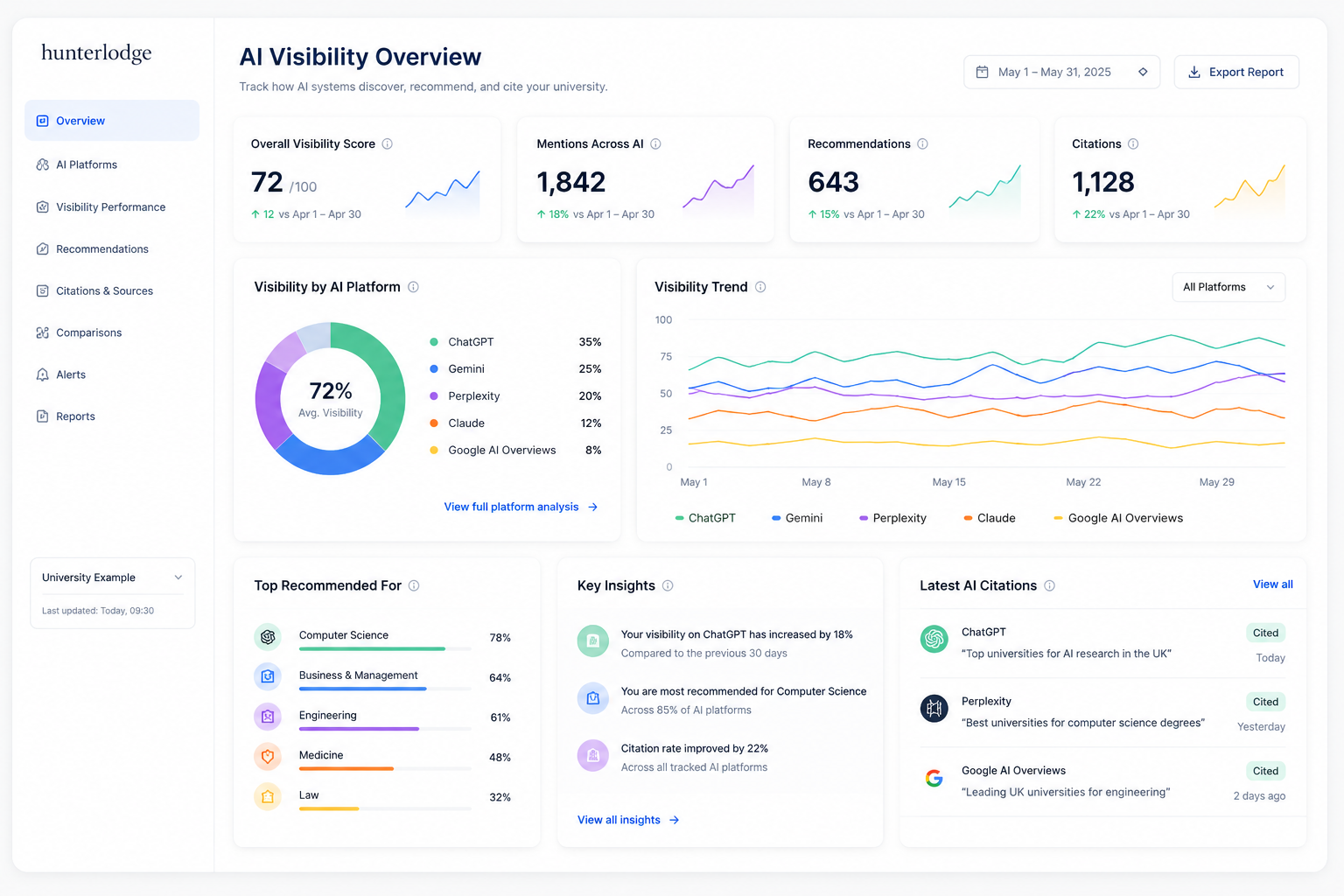
We test student-style prompts across AI systems to understand how universities are surfaced.


Visit Us
Hunterlodge Advertising
171 High Street
Rickmansworth
Hertfordshire
WD3 1AY
Drop us an email
HOW AI SYSTEMS DISCOVER UNIVERSITIES
Research, analysis, and practical guidance exploring how AI systems influence university discovery, comparison, recommendation, and visibility. Our work examines how platforms such as ChatGPT, Gemini, Claude, Perplexity, and Google AI Overviews shape student decision-making before a website visit ever occurs.
AI SEARCH BEHAVIOUR
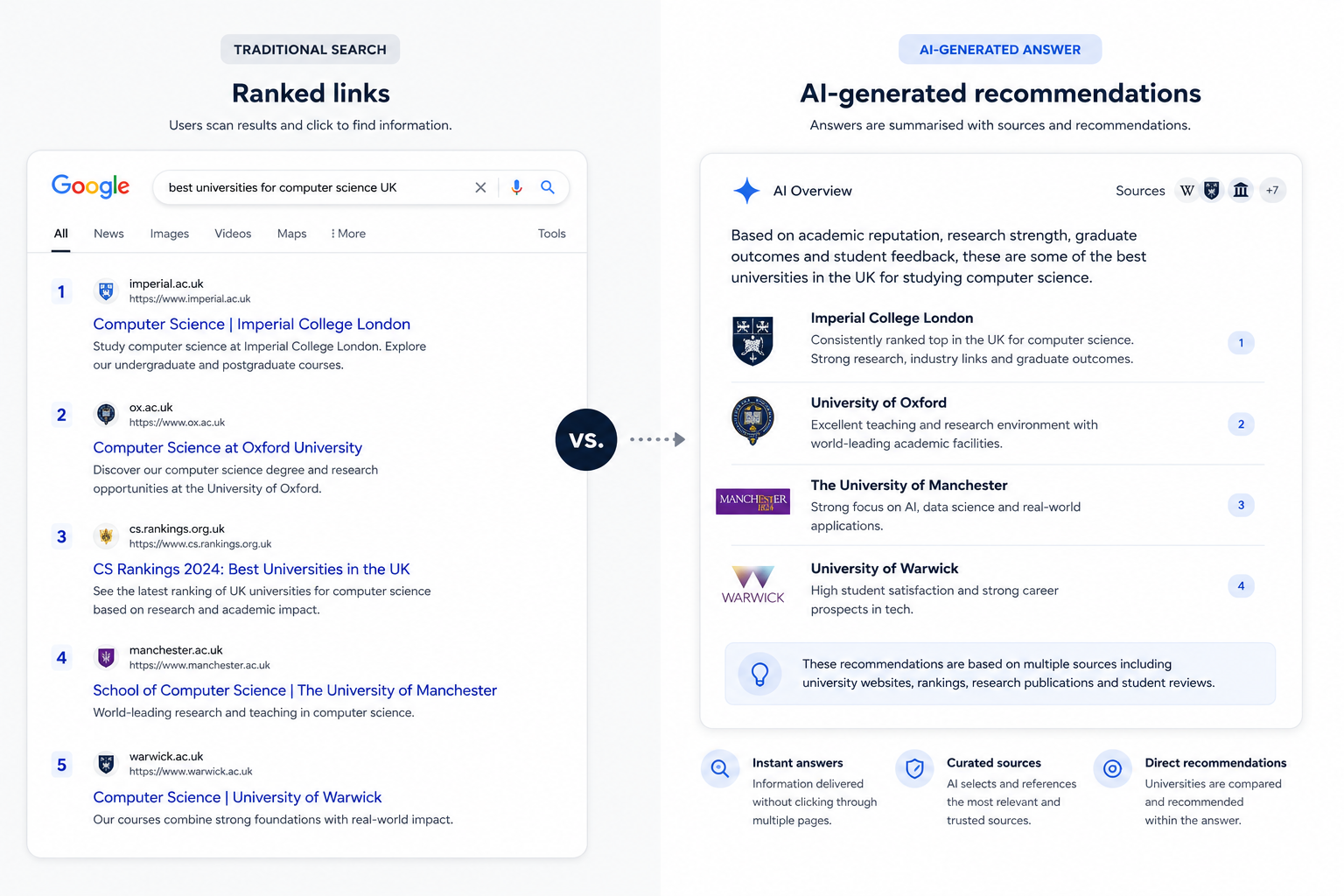
Students are starting to ask AI systems the kind of questions they used to type into Google. They ask which universities are best for a subject, which courses offer strong teaching, which institutions are good for careers, or which options fit a specific location, budget, or goal.
The answer they receive is not just a list of links. It is usually a written response, often with a shortlist, a comparison, or a recommendation. That means a university can be included, ignored, praised, or misunderstood before the student has reached the university website.
This simulation shows why that matters. It gives a simple view of how AI-generated answers can influence discovery, comparison, and early decision-making.
AI VISIBILITY ANALYSIS
AI visibility is not measured in the same way as traditional search performance. Universities appearing prominently in Google rankings are not always the institutions surfaced inside AI-generated recommendations, comparison prompts, or conversational search responses.
At Hunterlodge, we focus on how AI systems retrieve, prioritise, compare, and reference universities across different search scenarios. This includes analysing recommendation patterns, citation behaviour, external source influence, prompt interpretation, and retrieval consistency across multiple AI systems.
By studying how AI-generated answers are constructed, we can identify the visibility signals influencing university discovery before users ever click through to an institutional website.
PLATFORMS ANALYSED
There is no single AI search experience. Each platform uses different models, different retrieval methods, different source relationships, and different approaches to answering questions.
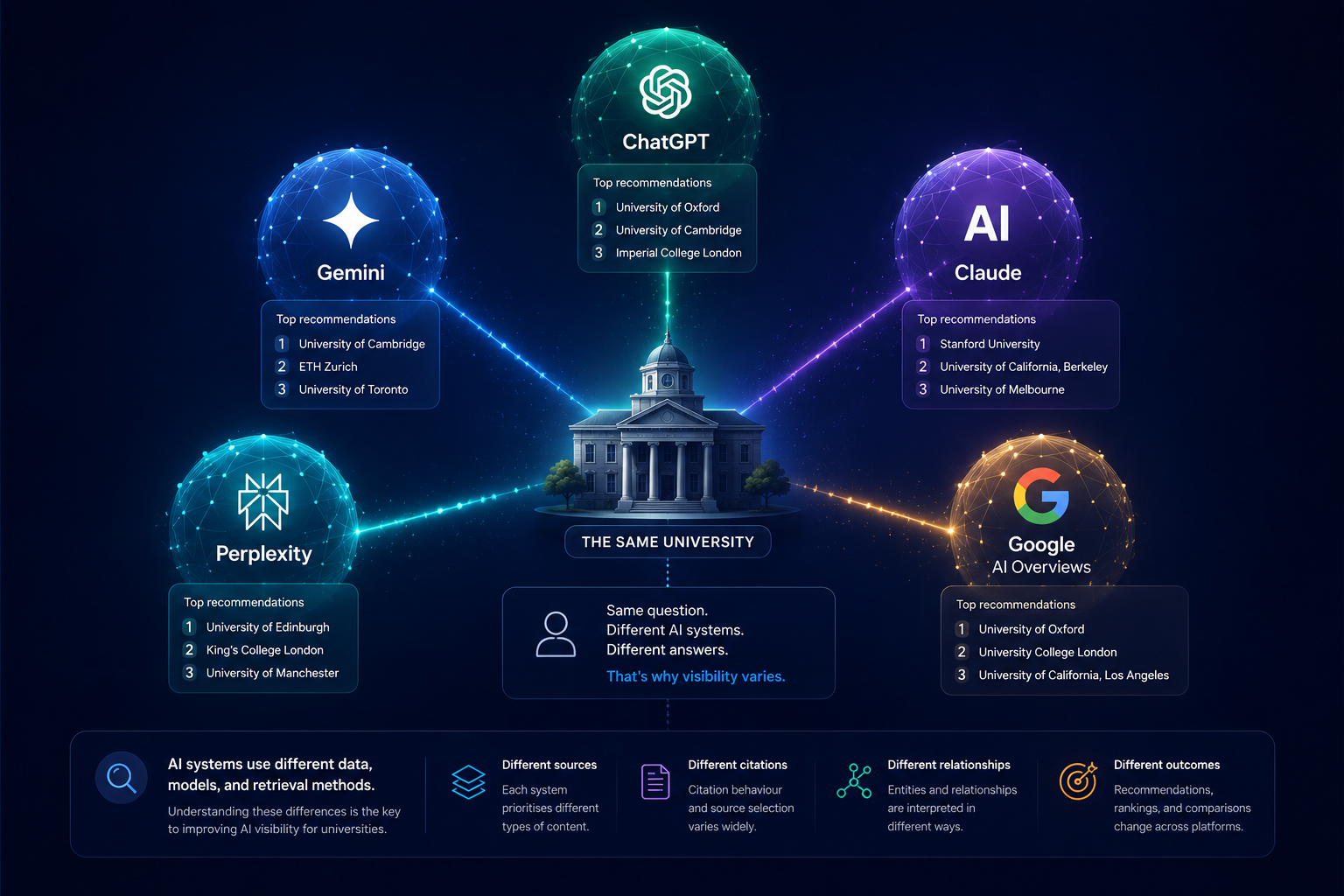
As a result, the same prompt can produce very different recommendations depending on where it is asked. A university that appears prominently in one platform may be absent from another.
Our research examines these differences directly. By analysing multiple AI systems side by side, we can identify common patterns as well as platform-specific behaviours that influence visibility.

The most widely used conversational AI platform. ChatGPT is often used by prospective students to compare universities, explore courses, understand career options, and ask follow-up questions throughout the research process.
Google's AI assistant, integrated across Search and other Google products. Gemini influences how university information is discovered and presented through Google's growing AI-powered search experience.

Known for handling longer conversations and detailed analysis. Claude is frequently used to evaluate options, compare institutions, and explore more complex higher education questions.
An AI search platform built around citations and source transparency. Perplexity is often used by students who want answers backed by links, references, and supporting evidence.

Google's AI-generated summaries that appear directly in search results. These responses can influence university visibility before users click through to websites or external sources.
No two AI systems produce exactly the same answers. By analysing the same university questions across multiple platforms, we can identify differences in recommendations, sources, visibility, and citation patterns.
PLATFORM DIFFERENCES
Different AI systems produce different university recommendations, citations, and comparison results even when responding to similar prompts. ChatGPT, Gemini, Claude, Perplexity, and Google AI Overviews each use different retrieval models, citation patterns, source relationships, and answer construction approaches.
Some AI systems rely heavily on publisher websites, rankings, forums, and external review platforms, while others prioritise conversational summarisation, citation diversity, or multimodal retrieval behaviour. These differences influence which universities appear, how often institutions are referenced, and which external sources shape visibility.
RESEARCH AREAS
AI visibility is influenced by many different factors. The way AI systems find information, choose sources, compare universities, and respond to questions all affects which institutions appear in generated answers.
Because of this, we do not treat AI visibility as a single topic. We break it into a number of research areas so we can study specific parts of the process in more detail and understand what influences visibility at each stage.
These research areas form the foundation of our research programme and guide the papers, frameworks, and analysis published through this hub.
How AI systems find, select, and use university information before generating a response. This research looks at where information comes from, which sources are chosen, and what content is most likely to be included in answers.
How AI platforms decide which universities to mention, compare, shortlist, and recommend. This area looks at the factors that influence recommendations across different student questions and search scenarios.
Which sources AI systems rely on when generating university answers. This includes rankings, publishers, directories, university websites, forums, and other third-party sources that regularly appear in AI-generated responses.
How prospective students use AI during the university research process. This research focuses on the questions students ask, how they compare institutions, and where AI influences decision-making before a website visit.
Why some universities appear regularly in AI-generated answers while others do not. This area looks at the content, sources, and signals that influence visibility across different AI platforms.
How ChatGPT, Gemini, Claude, Perplexity, and Google AI Overviews respond to the same university questions. By comparing outputs side by side, we can identify differences in recommendations, citations, source selection, and visibility.
KEY RESEARCH OBSERVATIONS
AI visibility is influenced by many different factors. The way AI systems find information, choose sources, compare universities, and respond to questions all affects which institutions appear in generated answers.
Because of this, we do not treat AI visibility as a single topic. We break it into a number of research areas so we can study specific parts of the process in more detail and understand what influences visibility at each stage.
These research areas form the foundation of our research programme and guide the papers, frameworks, and analysis published through this hub.
78%
Of university recommendation answers analysed referenced third-party publishers, rankings, or aggregators before linking directly to institutional websites.
2.4x
Of university recommendation answers analysed referenced third-party publishers, rankings, or aggregators before linking directly to institutional websites.
1 in 2
Universities appearing strongly within AI-generated answers were not always the same institutions performing strongly in traditional search.
78%
Of university recommendation answers analysed referenced third-party publishers, rankings, or aggregators before linking directly to institutional websites.
RESEARCH METHODOLOGY
Understanding AI visibility starts with understanding how AI systems answer questions. Most platforms do not simply return a ranked list of websites. Instead, they retrieve information from multiple sources, interpret the user's request, and generate a response based on the information they consider most relevant.
Our research is designed to examine that process. We test university-related prompts across multiple AI platforms and analyse which institutions appear, how they are described, what sources are referenced, and how recommendations change depending on the question being asked.
We also compare results across different platforms. A university that appears regularly in ChatGPT may be less visible in Gemini or Perplexity. Understanding these differences helps identify where visibility exists, where it is missing, and what factors may be influencing the outcome. The goal is to understand how universities are represented inside AI-generated answers and what influences those representations.
AI VISIBILITY RESEARCH
AI-generated answers are becoming part of the university research process. Students use these systems to compare options, explore courses, and gather information long before they complete an enquiry form or visit a campus.
Understanding how your institution appears within those answers is becoming increasingly important. Our research, frameworks, and analysis are designed to help universities understand where they are visible, where they are not, and what may be influencing those outcomes.