
Millions of people now use tools like ChatGPT, Gemini, Perplexity and Google AI Overviews to answer questions that would previously have been typed into a search engine. Whether someone is researching a product, comparing services or exploring university options, AI-powered search tools are becoming part of how information is found online.
For organisations, this creates a new visibility challenge. Ranking well in Google is still important, but users are increasingly receiving answers before they reach a website. As a result, organisations need to understand whether AI platforms can find, understand and recommend them when relevant questions are asked.
The ability to be found within these AI-powered search experiences is known as AI visibility.
What Is AI Visibility?
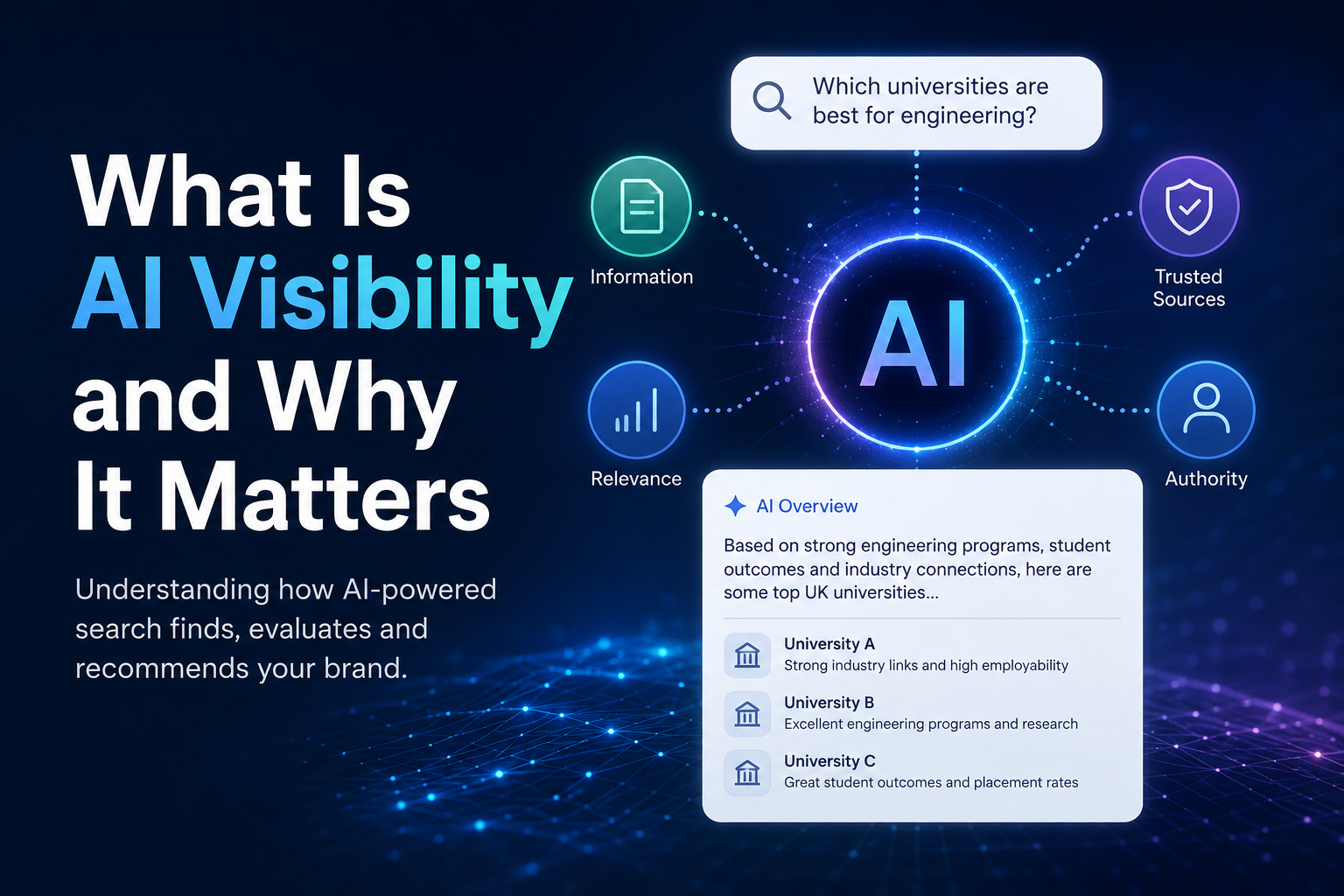
AI visibility refers to how easily an organisation, brand or website can be discovered and understood by AI-powered search platforms.
When someone asks an AI platform a question, the system has to determine which sources, organisations and pieces of information are relevant to the topic. The better an organisation is understood by the AI, the more likely it is to be surfaced when users search for related information.
For example, a prospective student might ask which UK universities are known for engineering, which universities offer strong placement opportunities, or which institutions are particularly attractive to international students.
The AI platform must decide which institutions are relevant to those questions and which information it should use to support its answer. Universities that are consistently associated with those topics are more likely to be surfaced.
This is what AI visibility is really about. It is the ability to be discovered when AI systems are deciding what information users should see.
AI visibility refers to how easily an organisation, brand or website can be discovered and understood by AI-powered search platforms.
When someone asks an AI platform a question, the system has to determine which sources, organisations and pieces of information are relevant to the topic. The better an organisation is understood by the AI, the more likely it is to be surfaced when users search for related information.
For example, a prospective student might ask which UK universities are known for engineering, which universities offer strong placement opportunities, or which institutions are particularly attractive to international students.
The AI platform must decide which institutions are relevant to those questions and which information it should use to support its answer. Universities that are consistently associated with those topics are more likely to be surfaced.
This is what AI visibility is really about. It is the ability to be discovered when AI systems are deciding what information users should see.
Why AI Visibility Exists
AI visibility has become important because AI search works differently from traditional search. The way information reaches users is changing, and organisations need to understand how that affects their ability to be discovered.
In a traditional search engine, users are presented with a list of links and decide which websites to visit. Even if a website ranks below competitors, there is still an opportunity for users to scroll through the results and find it.
AI-powered search introduces another step into that process. Before information reaches the user, the platform evaluates available sources and decides what information is most relevant to the question being asked.
As a result, users often receive a summary, recommendation or direct answer before visiting a website. Organisations are therefore competing not only for rankings and clicks, but also for recognition within AI-powered search experiences.
How AI Search Finds Information
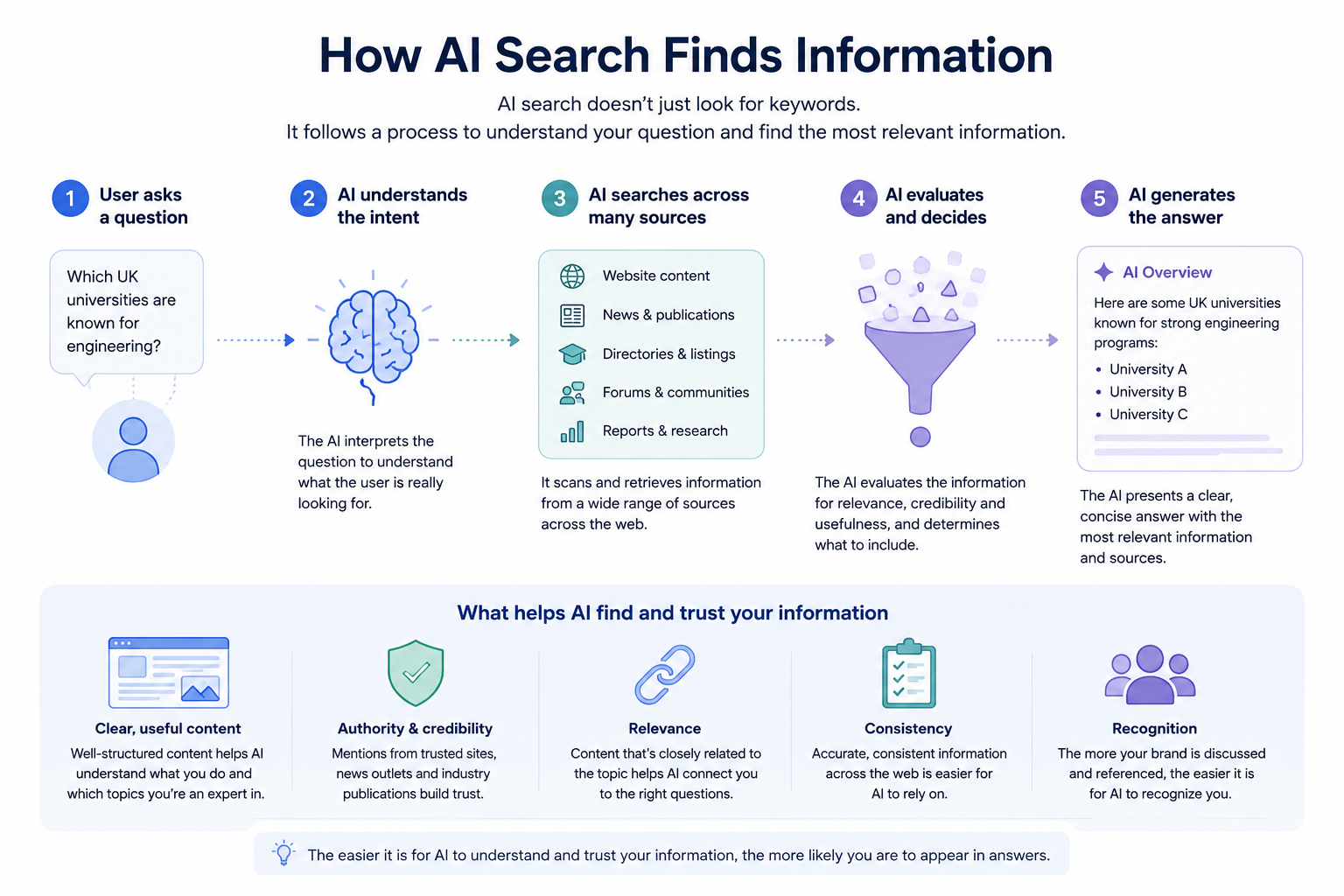
AI systems need information to understand organisations and topics. The more information that exists about an organisation, the easier it becomes for AI platforms to understand what that organisation does and when it may be relevant to a user's question.
When a user submits a query, the AI platform attempts to understand what they are asking and identify information that can help answer that question. To do this, it relies on a range of sources, signals and data points that help it understand relationships between topics, organisations and concepts.
For example, if someone asks which UK universities are known for engineering, the AI needs enough information to understand which institutions are associated with engineering, why they are relevant and whether they should be included in the answer. The same process takes place whether the user is researching a university, a software provider, a retailer or a financial service.
Organisations that are easier to understand and associate with specific topics are generally more likely to be discovered when users ask related questions. University websites that provide little information or have a weak online presence may find it harder to appear, even when they offer relevant products, services or expertise.
What Influences AI Visibility?
AI visibility is influenced by a combination of factors rather than a single ranking signal. AI platforms need enough information to understand what an organisation does, whether it can be trusted and when it is relevant to a user's question.
The information available on an organisation's website plays a role because it helps AI systems understand its products, services and areas of expertise. Information published elsewhere on the web also matters because it provides additional context and validation.
Mentions from trusted sources, consistent information across multiple channels and a strong association with relevant topics can all contribute to how easily an organisation is understood by AI platforms. While different AI systems use different methods, organisations that are well understood online are generally in a stronger position to be discovered.
AI Visibility vs Traditional Search
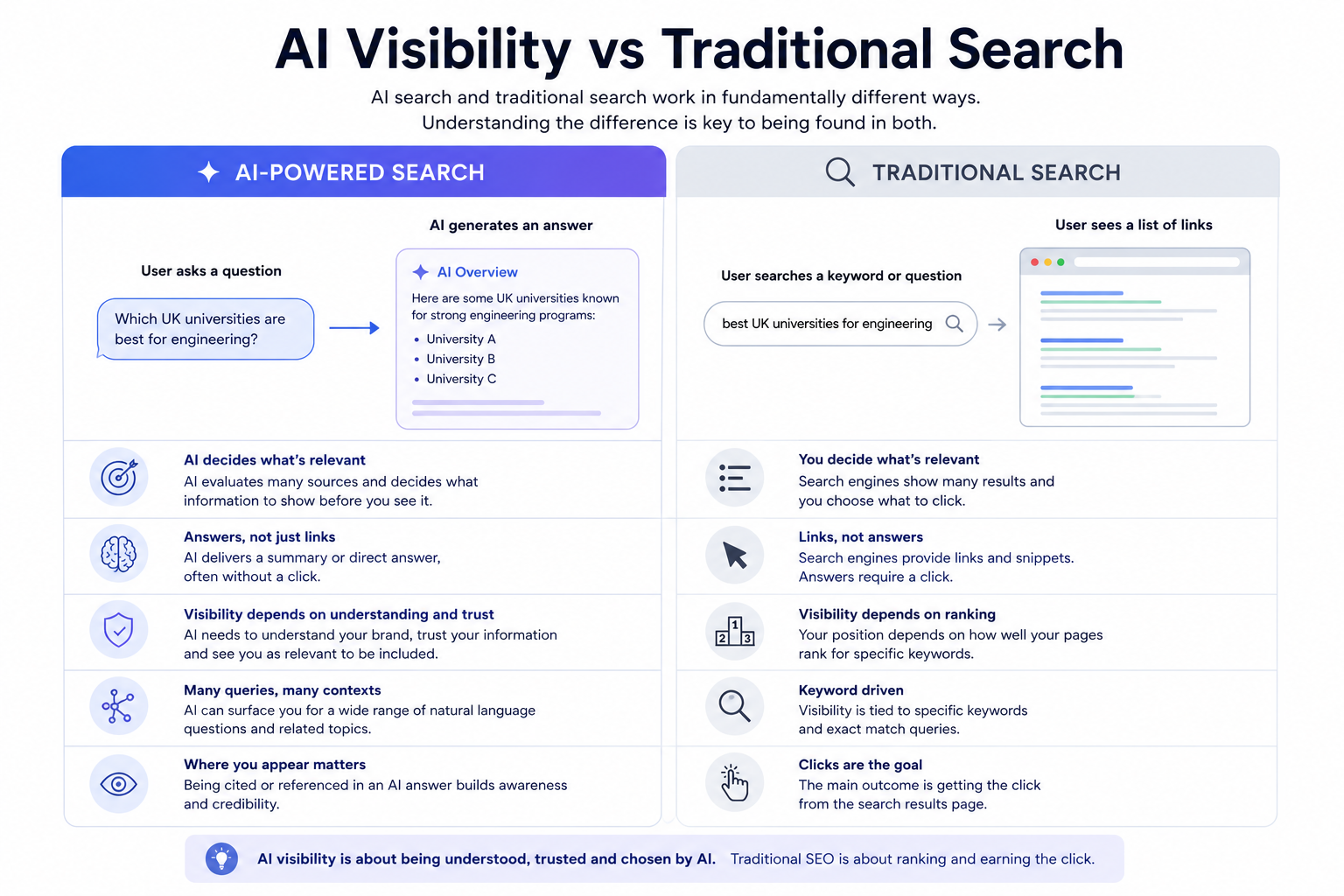
Unlike traditional search, AI visibility does not come with a simple ranking position that can be checked every day. An organisation may appear prominently for one question and be absent for another, depending on the topic being discussed and the information available to the AI platform.
Imagine a prospective student asks which UK universities offer strong placement opportunities. The AI platform may respond by highlighting several institutions and providing supporting information about their programmes, industry partnerships and graduate outcomes.
Those universities have achieved visibility within that search experience because the AI determined they were relevant to the user's question. Another university may appear when someone asks about student support, while a different institution may be mentioned when discussing engineering or postgraduate study.
The same thing happens across thousands of industries and topics every day. People ask questions, AI systems evaluate available information and organisations are surfaced based on their relevance to the query.
This means AI visibility and research is not tied to a single keyword or ranking position. It is influenced by how well an organisation is understood across a wide range of related topics and questions.
Why AI Visibility Matters
AI visibility matters because it affects whether people discover your organisation during their research process. If users increasingly rely on AI tools to find information, the organisations surfaced within those experiences gain an opportunity to be considered much earlier in the decision-making journey.
Many users now treat AI platforms as a starting point for research. They ask questions, compare options and build an initial understanding of a topic before deciding which websites, organisations or providers they want to investigate further.
If an organisation appears regularly when relevant questions are asked, it gains exposure during a stage where opinions and preferences are often being formed. This can increase awareness and create opportunities to reach potential customers before competitors do.
The opposite can also happen. If competing organisations are consistently being surfaced while your organisation is absent, potential customers may never become aware of your brand during an important stage of their research.
This does not mean traditional SEO has stopped mattering. Search engines remain one of the most important ways people discover information online, but AI-powered search is becoming another channel through which organisations are found, researched and evaluated.
Understanding AI visibility helps organisations understand how they are represented within AI-powered search and whether they are being discovered when it matters most.
AI Visibility vs AI Discovery
AI visibility and AI discovery are closely connected. AI discovery refers to the process of being found and understood by AI systems, while AI visibility refers to the outcome of that process.
When an organisation is easy for AI systems to understand, it becomes easier for those systems to connect that organisation to relevant topics and user questions. This increases the likelihood of the organisation appearing when people search for related information.
For example, if a university is strongly associated with engineering, student support and graduate employability, AI platforms are more likely to connect that institution to questions about those subjects. If the platform lacks information or confidence in its understanding of the university, it may choose to surface other institutions instead.
The same principle applies to businesses, charities, government organisations and every other type of organisation. Being discoverable helps create visibility, and visibility creates opportunities to be considered during the research process.
Final Thoughts
AI visibility refers to how easily an organisation, brand or website can be discovered and understood by AI-powered search platforms. It is ultimately about whether AI systems can recognise an organisation, understand what it is known for and connect it to relevant user questions.
As more people use AI tools to research topics, compare options and find information, organisations need to think beyond traditional search rankings alone. Understanding AI visibility helps organisations assess whether they can be found within these new search experiences and whether they are appearing when relevant questions are asked.
The organisations that pay attention to AI visibility today will be in a stronger position to understand how they are being discovered, represented and recommended as AI-powered search becomes a more common part of everyday research.